There’s a specific kind of frustration that only fundamental investors understand.
You spend weeks studying annual reports, tracking management commentary, and filtering companies through the holy trinity of ROE, ROCE, and consistent sales growth. You carefully build a portfolio of “high-quality” businesses backed by months of research and conviction. Then six months later, you open your portfolio and realize something deeply irritating:
A “boring” Nifty 50 ETF , filled with companies you would never personally buy at current valuations is outperforming your carefully selected portfolio. It stings.
Not just financially, but psychologically. Because at some point, investing stops being about returns and starts becoming a battle between ego and probability. And if you want to build a realistic long-term portfolio, you need to stop trying to be the hero of every market cycle and start respecting the mathematics of portfolio construction.
The Anchor and the Sail Portfolio Strategy
A good portfolio is not a collection of stocks. It is a system. Think of your portfolio as a ship, the Nifty 50 ETF is the anchor and your high-conviction stock picks are the sail. They both matter.
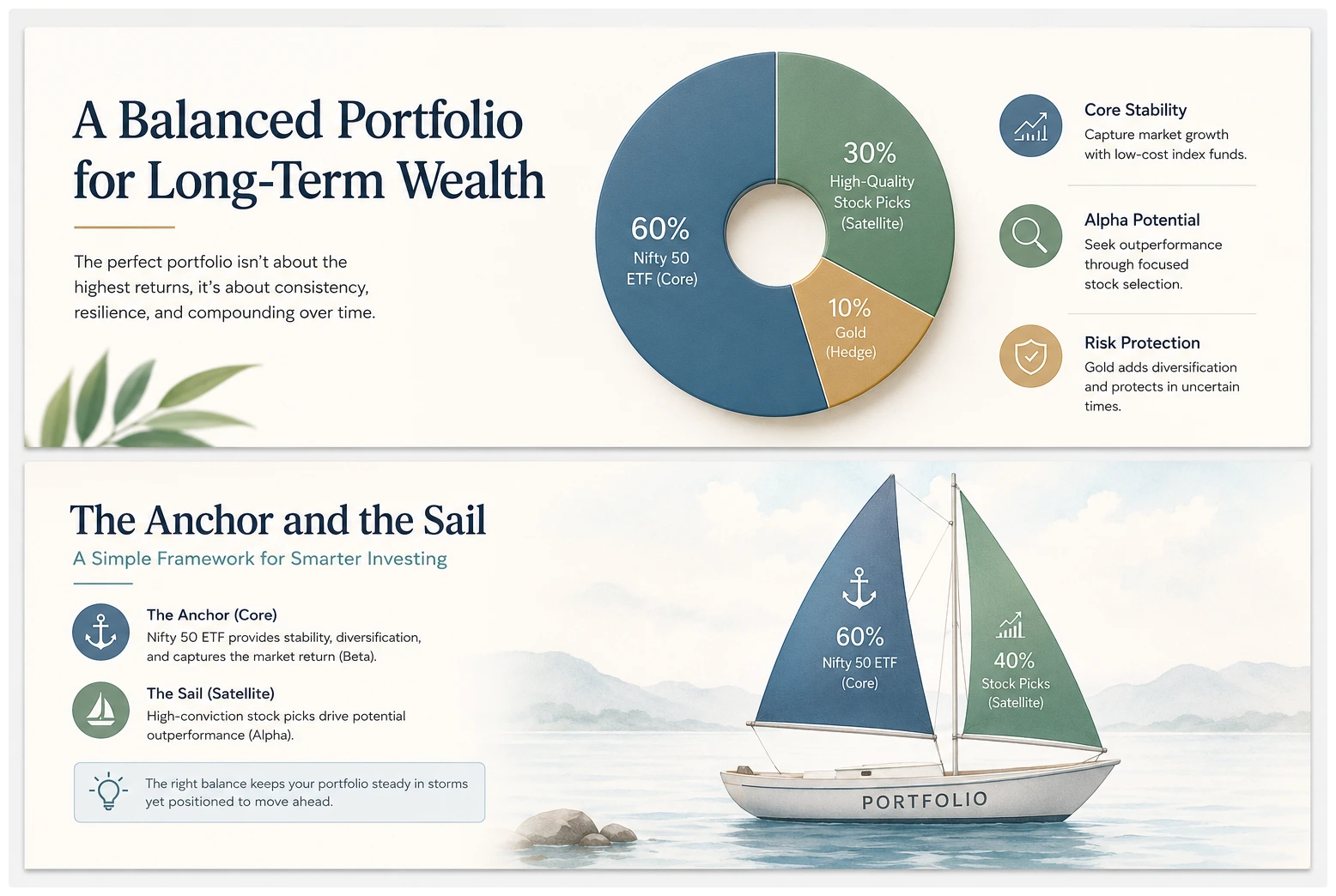
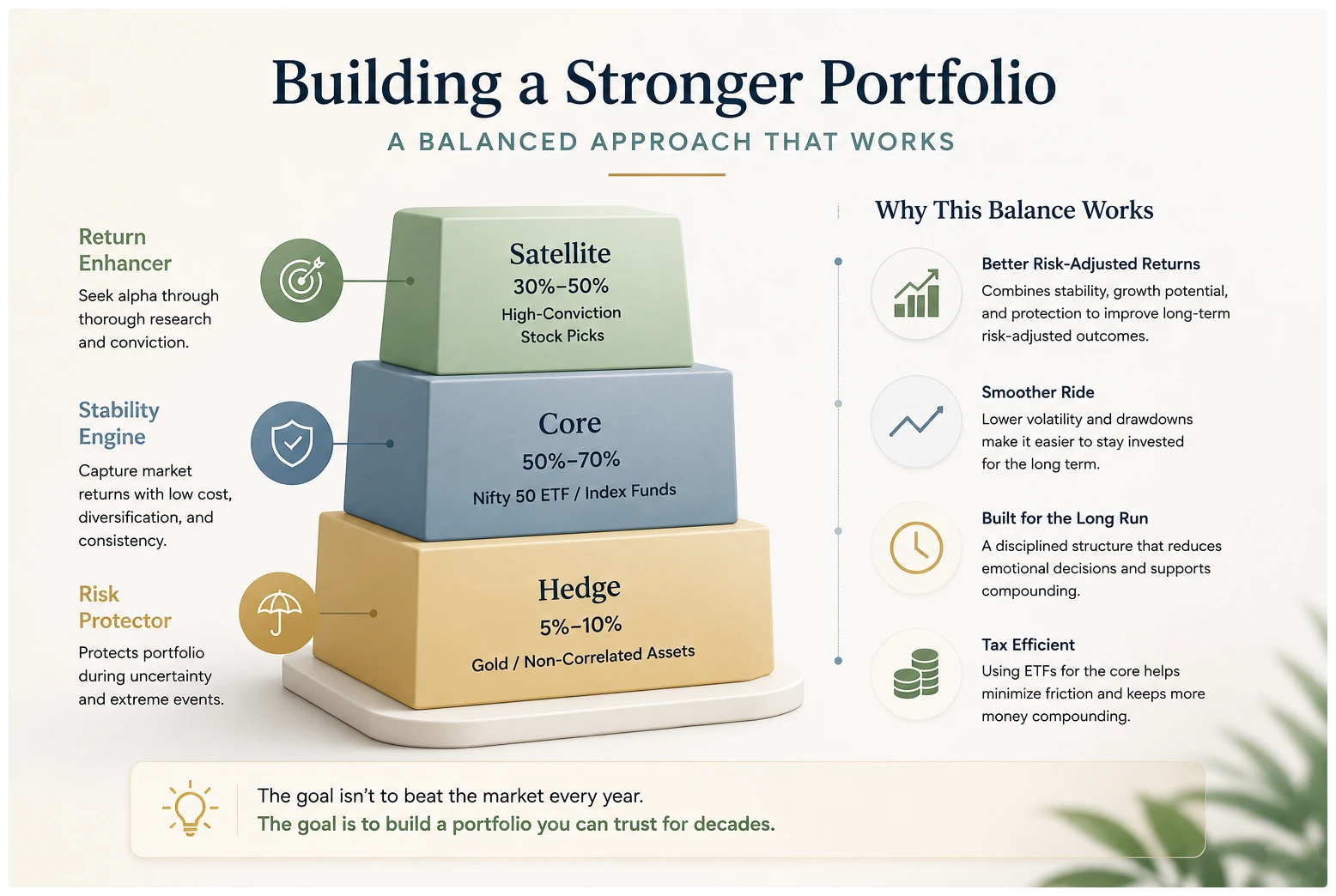
Too much sail and the portfolio becomes unstable during periods of volatility. Too much anchor and your returns simply mirror the market forever. The balance is what matters. For most long-term investors, a portfolio with 50–70% allocated to index funds or ETFs and 30–50% allocated to carefully selected businesses …usually creates a far more sustainable investing experience than going all-in on concentrated stock picking.
The ETF captures market beta meaning the broad return generated by the economy and corporate growth over time. Your individual stock selections are where you seek alpha meaning excess returns above the market average.
But here’s the uncomfortable truth Alpha is far harder to generate consistently than most naive investors believe.
Why Index Investing Often Wins
One of the biggest misconceptions in investing is that intelligence automatically translates into superior returns. It doesn’t.
Markets are brutally competitive systems filled with institutional capital, algorithms, professional fund managers, insider industry expertise, and global liquidity flows. Even excellent businesses can remain flat for years if valuations become stretched.
Meanwhile, a broad-market ETF quietly compounds in the background with lower friction, lower volatility, automatic diversification, and almost no emotional decision-making.
That simplicity is not a weakness. It is an advantage.
The Metrics That Actually Matter: Sharpe and Sortino Ratios
Most investors obsess over returns but sophisticated investors obsess over risk-adjusted returns.
Imagine two investors who both generate 15% annual returns.
- Investor A experiences violent swings every few weeks.
- Investor B compounds steadily with smaller draw-downs and smoother performance.
On paper, both earned the same return. In reality, Investor B built the superior portfolio. That’s where metrics like the Sharpe Ratio and Sortino Ratio become important.
The Sharpe Ratio measures how efficiently a portfolio generates returns relative to overall volatility. The Sortino Ratio goes a step further by focusing only on downside volatility; well, the painful part investors actually care about.
A strong ETF allocation naturally improves both. It acts as a shock absorber when individual stock positions go through temporary under-performance, sector corrections, or valuation resets.
And psychologically, smoother portfolios are easier to hold during difficult periods. That matters more than most people realize.
If you are new to investing and feeling overwhelmed by these geeky jargons, you can read my earlier post to simplify your understanding of a perfect portfolio strategy.
The High-Quality Stock Illusion
Investors often assume that buying “great businesses” automatically protects them from poor outcomes. It doesn’t.
A great company can still be a terrible investment if: growth slows, expectations become unrealistic, or valuations run too far ahead of fundamentals. Even elite businesses can experience multi-year periods where stock prices remain flat while earnings slowly catch up.
This creates a dangerous emotional cycle. You buy quality. The stock goes nowhere. Frustration builds. Conviction weakens. Eventually, you exit near the bottom of sentiment. A broad-market ETF helps bridge that emotional gap.
While your high-conviction bets go through temporary stagnation, the broader market continues compounding in the background. That steady “heartbeat” inside the portfolio is more important than chasing perfection.
Friction Is the Silent Wealth Killer
Returns alone do not determine long-term wealth creation.
- Friction matters
- Taxes pull you back
- Costs are unavoidable
- Behavior is imprtant
If you are still in the accumulation phase of investing, constant portfolio churn can quietly destroy compounding through taxes, transaction costs, poor timing decisions, and emotional over trading.
This is one reason ETFs work exceptionally well as the core of a portfolio. They are tax-efficient, low-cost, diversified, and structurally simple.
Instead of constantly reacting to market narratives, your capital remains focused on uninterrupted compounding. And over decades, uninterrupted compounding is incredibly powerful.
Why Gold Still Deserves a Place in a Portfolio
No portfolio is truly complete without at least one non-correlated asset. That is where gold becomes useful. Not because it always generates spectacular returns. But because it often behaves differently when financial markets experience stress.
A modest 5–10% allocation to gold …can improve portfolio resilience during inflationary periods, currency uncertainty, geopolitical instability, or equity market draw downs.
Gold is not there to outperform your equities. It is there to stabilize the portfolio when uncertainty rises. And statistically, even small allocations to non-correlated assets can significantly improve long-term risk-adjusted returns.
If you are still unsure about how gold fits into a perfect portfolio strategy, we’ve got you covered. You can read our earlier article for a detailed breakdown by clicking here.
The Real Goal of Portfolio Construction
The perfect portfolio is not the one with the highest theoretical return. It is the one you can realistically hold through crashes, stagnation, euphoria, panic, and boredom.
That is the real challenge.
Most portfolios fail not because they lack intelligence, but because they lack sustainability. A strong long-term portfolio usually looks surprisingly simple:
- A solid core built around low-cost index investing,
- A selective layer of high-conviction businesses,
- and a small hedge against uncertainty.
It may not look exciting at a cocktail party. But over a 10–15 year period, it will likely outperform most emotionally driven portfolios built on prediction, concentration, and constant tinkering.
And in investing, survival with consistency almost always beats brilliance with instability.
Frequently Asked Questions (FAQs)
1. What is a perfect portfolio strategy?
A perfect portfolio strategy is a balanced investment approach that combines index funds, individual stocks, and diversification assets like gold to improve long-term risk-adjusted returns.
2. Why do index funds often outperform stock pickers?
Index funds outperform many investors because they offer broad diversification, lower costs, reduced emotional decision-making, and consistent exposure to market growth.
3. What is the difference between alpha and beta in investing?
Beta refers to overall market returns, usually captured through ETFs or index funds, while alpha represents excess returns generated through active stock selection.
4. Why is gold important in a long-term portfolio?
Gold helps stabilize a portfolio during inflation, market volatility, and economic uncertainty because it often behaves differently from equities.
5. What allocation works best for a balanced portfolio?
Many long-term investors prefer allocating 50–70% to index funds or ETFs, 30–50% to high-conviction stocks, and a small portion to gold for diversification.